

Intent-Based Prospecting: Turn LinkedIn Buying Signals Into Outreach
Published · Updated · Zyaam Ali
Practical guidance for founders, B2B teams, and small agencies turning buyer signals into reviewed next actions.
Photo by Vitaly Gariev on Unsplash
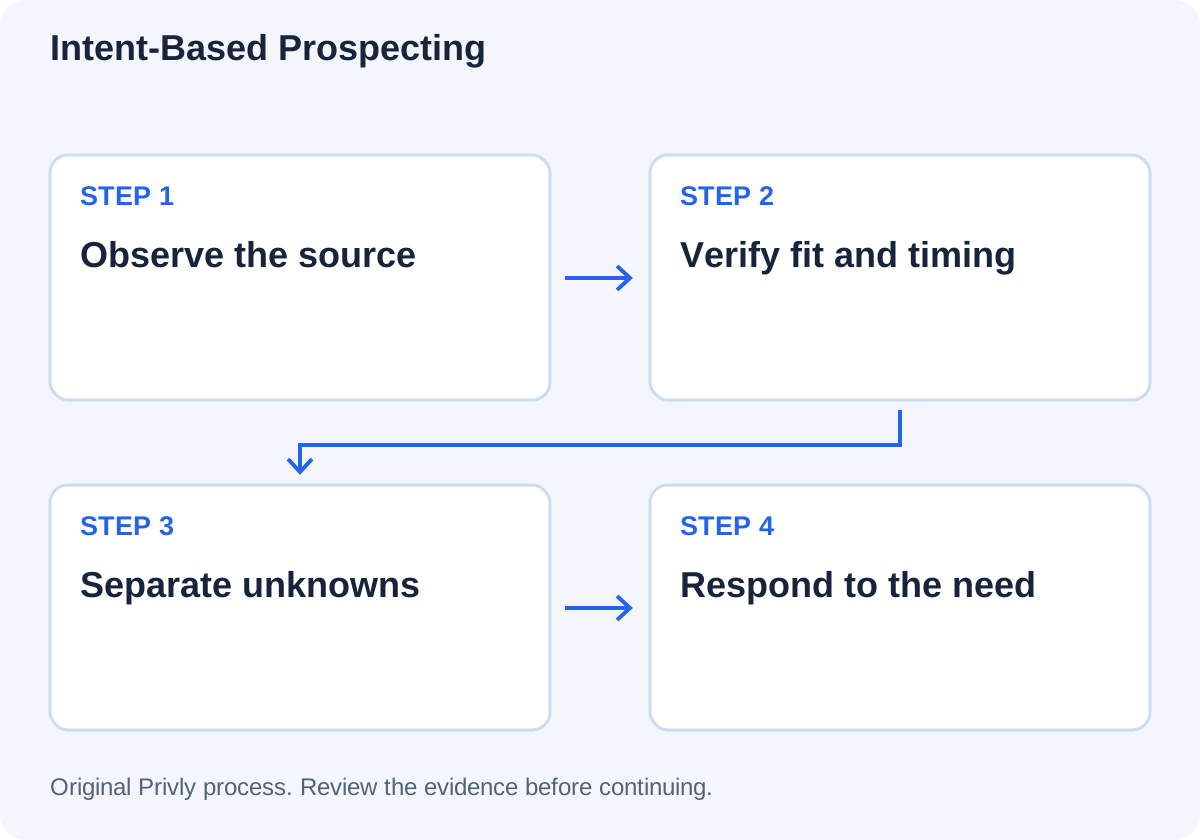
A prospect asks for software recommendations. Another announces funding. A third likes a competitor’s post. Those actions do not express the same need. Intent-based prospecting connects a specific observation to a relevant offer, checks customer fit, and chooses an appropriate next action. This guide gives you a signal-to-action matrix, a research record, and original examples for doing that work.
What intent-based prospecting actually evaluates
Buying intent is evidence that someone is working toward a relevant decision. Customer fit asks whether your business can serve the company and person. Keep those questions separate. A strong problem statement does not overcome a required integration you cannot supply; an ideal account may have no current project.
An event becomes useful when you can connect it to a problem your offer addresses. Preserve the original statement, date, and source. Write your interpretation separately. That separation gives the next reviewer a chance to disagree without losing the underlying fact.
The distinction is consistent with HubSpot’s scoring documentation, which separates fit properties from engagement actions. Engagement alone does not resolve the buyer’s situation in this workflow.
Choose an action that matches the evidence
Do not assign the same outreach to every mention of your category. Use the matrix as a review aid. Its categories describe your operating decisions, not a prediction that the prospect will buy.
| Observed evidence | What it supports | Next action |
|---|---|---|
| A like or broad industry comment | Topic interest only | Research fit; do not claim a project exists. |
| Funding, hiring, or expansion | A change in the business | Investigate whether the change creates a supported problem. |
| A dated description of a relevant problem | A reason to understand the workflow | Verify identity and fit; consider a useful question. |
| A request for tools with stated requirements | Evidence of evaluation | Check required capabilities before a specific response. |
| A direct request for a demo or quote | Interest in a purchase discussion | Respond to the request and confirm remaining requirements. |
| A refusal, closed project, or failed requirement | A stop or exclusion condition | Stop this approach; retain the reason. |
The buying-signals guide covers the signal categories. Use the fit and intent scorecard if a larger queue needs consistent review priorities.
From evidence to the next action
Build a record another reviewer can reproduce
Capture company and profile links, the original source, publication date when available, observation date, a short evidence excerpt, and the client or offer it may fit. Record missing information and the next-review decision. If a source cannot be opened, mark that limitation rather than presenting the summary as verified.
Check whether the statement refers to the person’s current company, a previous role, or a hypothetical example. Deduplicate reposts and copied announcements. Several observations about the same decision can add context, but they should not create several leads for the same person.
Freshness depends on the event. A request tied to a procurement deadline needs a different review date from a general discussion of a recurring problem. When evidence expires, move it out of the active rationale and ask whether the project still exists. Do not make old interest appear recent.
Worked example: turn a tool request into a useful reply
Imagine a consultancy that helps agencies repair sales-to-delivery handoffs. Its required condition is access to a supported project system. The prospect’s post asks for a way to prevent work being lost between sales and delivery.
| Check | Fictional finding | Consequence |
|---|---|---|
| Identity | Current operations lead at a B2B agency | Relevant role confirmed. |
| Problem | The post says the next owner is often unclear | A specific workflow question is supported. |
| Required system | Not named in the post | Compatibility remains unknown. |
| Timing | The team is reviewing its process this quarter | Useful context, not a purchase commitment. |
This response uses the observed problem and makes the commercial connection clear. It does not claim the buyer is replacing software. Before sending, review channel eligibility and the applicable requirements in the CASL guide where relevant.
Match follow-up to the answer
If the person identifies a supported problem, clarify the desired outcome before asking for a meeting. If the required system is unsupported, say so and stop pursuing that offer. If they want a resource, deliver it. A reply that says later should lead to an agreed next-review date rather than an unchanged sequence.
Keep the reply and the original evidence together for the next owner. Once the buyer has stated their needs directly, update your understanding instead of repeating the public signal as though nothing has changed. Your research is a starting point for a conversation.
Use the sales-call handoff guide when a specific next discussion is agreed. Named ownership and a confirmed meeting purpose matter more than a high intent label.
Review mistakes and missed opportunities
Inspect accepted leads for unsupported claims and excluded leads for requirements that were applied incorrectly. Track reasons: wrong identity, stale evidence, failed fit, no relevant problem, or an unanswered question. Keep source quality separate from message performance.
Common mistakes include treating competitor engagement as permission to pitch, counting one event several times, and allowing urgency to override an exclusion. A useful review ends with a corrected fact or decision, not simply a lower confidence number.
For a new offer, start with a small group your team can review fully. Keep a dated brief and change one criterion at a time. Positive replies and qualified meetings can inform the next version, but a short run cannot establish that one signal caused the outcome.
Intent-based prospecting questions
Use Privly’s free ICP identifier to make the offer and exclusions clear, then review prospect evidence against that profile.
Research and source notes
Sources reviewed October 23, 2026. Examples and calculations are authored illustrations; vendor documentation describes capabilities rather than comparative performance.
 CASL
CASL and Outbound Sales: Email and LinkedIn Prospecting in Canada
Review Canadian outbound email and LinkedIn messaging under CASL with official sources, consent and exemption distinctions, and a practical evidence checklist.
October 23, 2026 · Zyaam Ali Canadian B2B
Best LinkedIn Prospecting and Outreach Tools for Canadian Teams
Choose LinkedIn prospecting tools for a Canadian team with a sourced shortlist, CAD pricing context, review controls, and a practical selection worksheet.
October 23, 2026 · Giress Kenn AI Prospecting
AI Outreach Tools vs Manual Prospecting: Which Workflow Fits?
Compare AI-assisted and manual prospecting by task, review effort, evidence quality, and cost with a fair pilot plan and worked example.
October 23, 2026 · Zyaam Ali