

CASL and Outbound Sales: Email and LinkedIn Prospecting in Canada
Published · Zyaam Ali
Practical guidance for founders, B2B teams, and small agencies turning buyer signals into reviewed next actions.
A sales team finds an email address on a company website and a relevant person on LinkedIn. Can it send the same pitch through either channel? The answer depends on the message, the address, and the facts supporting consent or an exemption. This general guide helps teams structure that review using official CASL sources. Get qualified legal advice when the facts or interpretation are uncertain.
Start with the message and the electronic address
CASL is Canada’s anti-spam framework. For outbound prospecting, begin by asking whether one purpose of the message is to encourage commercial activity and whether it is sent to an electronic address. The substance, links, and context matter; calling something networking does not settle its purpose.
Section 6 of the Act addresses commercial electronic messages and, subject to applicable exceptions, requires consent and prescribed message content identifying the sender, enabling contact, and providing an unsubscribe mechanism.
The CRTC FAQ distinguishes general social broadcasts from direct messages and specifically includes LinkedIn messaging as an electronic-address example. Do not assume a commercial direct message falls outside CASL because it is sent on social media.
Check Canadian scope and relationship dates
Section 12 connects a section 6 contravention to a computer system in Canada used to send or access the message. A sender’s office location alone does not settle the review. Consider the actual communication and any applicable exemption.
Section 10(10) describes existing-business-relationship conditions, including specified transactions within two years, qualifying inquiries or applications within six months, and certain current or recently expired written contracts. Check the relevant condition and dates rather than applying one expiry rule to every form of implied consent. Subscription and other ongoing arrangements have additional timing provisions in section 10(14).
Distinguish consent from a complete exemption
Express consent and implied consent are different routes, with different evidence. A complete section 6 exemption is another question. Write down the route you intend to rely on and the exact facts supporting it before evaluating a message template.
| Route | Question to resolve | Evidence record |
|---|---|---|
| Express consent | What did the person actively agree to, for whom, and when? | Consent wording, action, date, scope, and withdrawal history. |
| Implied consent | Which statutory condition applies to these facts? | The relationship or publication evidence and any relevant time limit. |
| Section 6 exemption | Does the message meet every condition of the particular exemption? | Facts supporting each condition, not just the label B2B. |
CRTC implied-consent guidance explains that a request for express consent can itself be a commercial electronic message. An unsolicited email asking permission is not a general workaround for lacking a contact basis.
From evidence to the next action
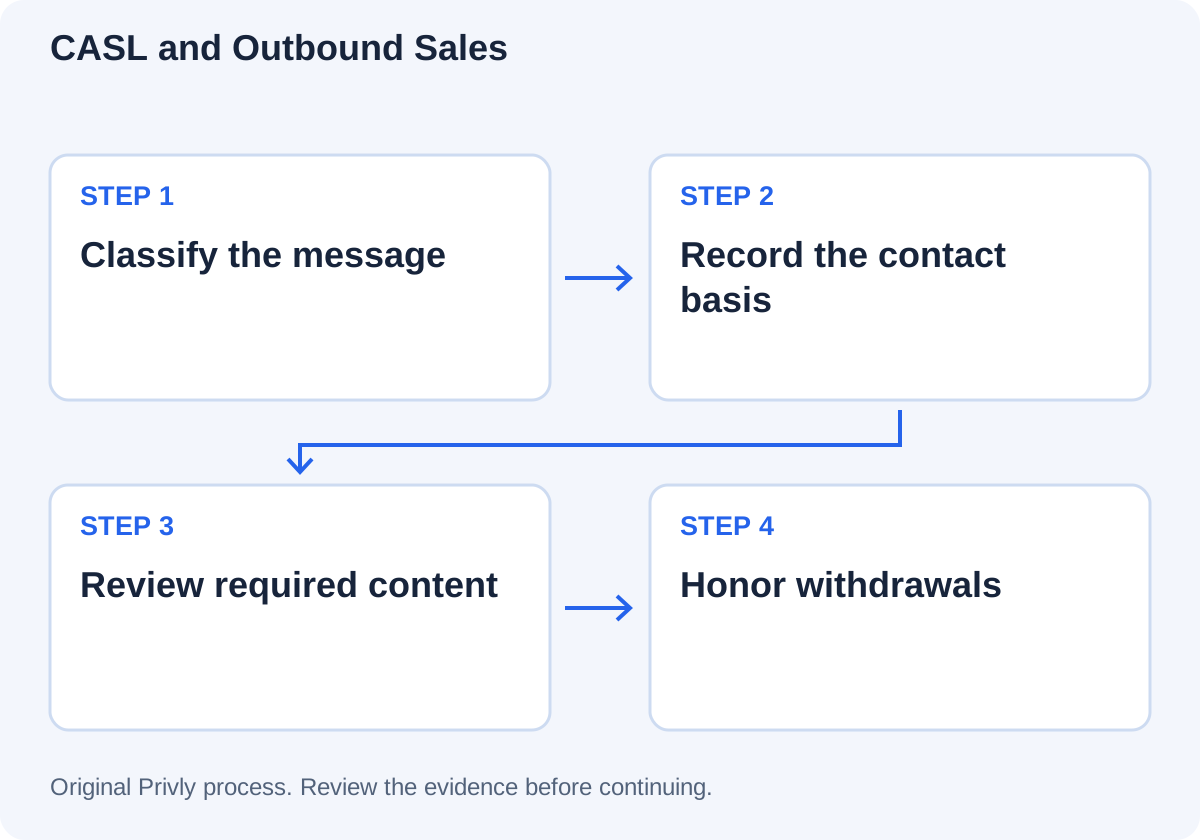
A public address is not a blanket licence
When considering conspicuous publication, verify the original source and who published or caused publication of the address. Retain the page and the role-related reason for the message. A purchased list entry or copied address does not, by itself, establish the required facts.
Section 10(9)(b) addresses conspicuous publication where there is no statement against unsolicited commercial messages and the message is relevant to the person’s business role, functions, or duties. Assess the actual conditions; a visible profile is not interchangeable with that evidence.
The B2B exemption requires a relationship between organizations
A recipient working for a business does not automatically exempt a cold pitch. Keep the organizational relationship separate from a personal connection between two employees.
Section 3(a)(ii) of the regulations covers messages between specified representatives of organizations where the organizations have a relationship and the message concerns the recipient organization’s activities. Section 3(b) separately addresses replies to a request, inquiry, complaint, or otherwise solicited messages.
Keep identification and unsubscribe handling operational
Where the section 6 content requirements apply, identify the sender and the party on whose behalf the message is sent, supply the required contact information, and include a workable unsubscribe mechanism. Agencies should agree who handles withdrawals across their delivery process.
Section 11 requires an unsubscribe mechanism without cost and effect to be given without delay, no later than 10 business days. Keep the contact details and mechanism valid for the required period; inspect the actual implementation instead of assuming a platform button covers every requirement.
For the prescribed details and implementation guidance, consult CRTC 2012-548. An operational stop request should reach the people controlling pending messages, not only the person who read the reply.
Use a contact decision record before launch
This is a suggested team worksheet, not a legal clearance engine. It helps a reviewer identify missing facts before a campaign moves ahead. Preserve the decision date so a changed relationship or withdrawal does not get lost behind an old approval.
| Field | Record before sending |
|---|---|
| Message and channel | Purpose, full draft, email/LinkedIn route, and intended recipient. |
| Sender | Actual sender and business represented. |
| Contact basis | Specific consent route or exemption, supporting facts, and reviewer. |
| Evidence | Original source, wording or request, dates, scope, and relevant limitations. |
| Required content | Identification, contact information, and unsubscribe handling where applicable. |
| Stop process | Who updates exclusions and pending sends when a withdrawal arrives. |
| Review status | Approved for this scope, needs evidence, or do not send. |
Pair this record with the Canadian prospecting worksheet and the campaign operating playbook. Relevance and permission are separate checks.
Questions about CASL and LinkedIn outreach
Use Privly’s free ICP identifier to clarify fit. Keep the contact-basis decision in your team’s reviewed process before initiating commercial outreach.
Research and source notes
Sources reviewed October 23, 2026. Examples and calculations are authored illustrations; vendor documentation describes capabilities rather than comparative performance.
 Canadian B2B
Best LinkedIn Prospecting and Outreach Tools for Canadian Teams
Choose LinkedIn prospecting tools for a Canadian team with a sourced shortlist, CAD pricing context, review controls, and a practical selection worksheet.
October 23, 2026 · Giress Kenn AI Prospecting
AI Outreach Tools vs Manual Prospecting: Which Workflow Fits?
Compare AI-assisted and manual prospecting by task, review effort, evidence quality, and cost with a fair pilot plan and worked example.
October 23, 2026 · Zyaam Ali LinkedIn Outreach
How to Increase Your LinkedIn Reply Rate
Diagnose LinkedIn reply rates with clear denominators, a worked funnel, original message revisions, and a practical experiment worksheet.
October 23, 2026 · Giress Kenn