

How to Increase Your LinkedIn Reply Rate
Published · Giress Kenn
Practical guidance for founders, B2B teams, and small agencies turning buyer signals into reviewed next actions.
Photo by Vitaly Gariev on Unsplash
Your connection requests are accepted, but the messages receive few useful answers. Sending more can make the problem harder to see. To increase your LinkedIn reply rate, first identify which people received a real message, what counts as a reply, and where the conversation stops. This guide gives you a diagnostic worksheet and a way to improve relevance without confusing replies with sales outcomes.
Define the rate before changing the message
For this guide, recipient reply rate is unique people who replied to campaign messages divided by unique people who received those messages, over a stated observation window. Count a person once even if they received several follow-ups or replied repeatedly. Keep external conversations and replies that predate the campaign outside that cohort.
Connection acceptance is a different funnel: accepted requests divided by people invited. A person who accepted but never received a direct message does not belong in the direct-message reply denominator. Label invitation-note responses separately if you track them.
Vendor reports can use different populations and denominators. The HeyReach benchmark report separates acceptance and reply measures. Read its definitions before comparing them with your own campaign.
Separate reactions from positive interest
A refusal, wrong-person response, or stop request is a reply. Positive interest means a reviewed response that advances a relevant conversation: asking for the resource you offered, explaining a supported need, or agreeing to a useful next step. A booked meeting and a held qualified call remain separate outcomes.
| Measure | Unique people | Calculation |
|---|---|---|
| People invited | 120 | Separate invitation cohort. |
| People who accepted | 48 | 48 / 120 = 40% acceptance. |
| People actually messaged | 40 | Reply-rate denominator. |
| People who replied | 8 | 8 / 40 = 20% recipient reply rate. |
| Positive replies | 3 | 3 / 40 = 7.5% positive reply rate. |
| Meetings booked | 2 | 2 / 40 = 5% messaged-to-booked rate. |
These numbers explain the calculation; they are not performance targets. Keep scheduled future meetings pending and record held, cancelled, missed, or rescheduled outcomes after the agreed date.
From evidence to the next action
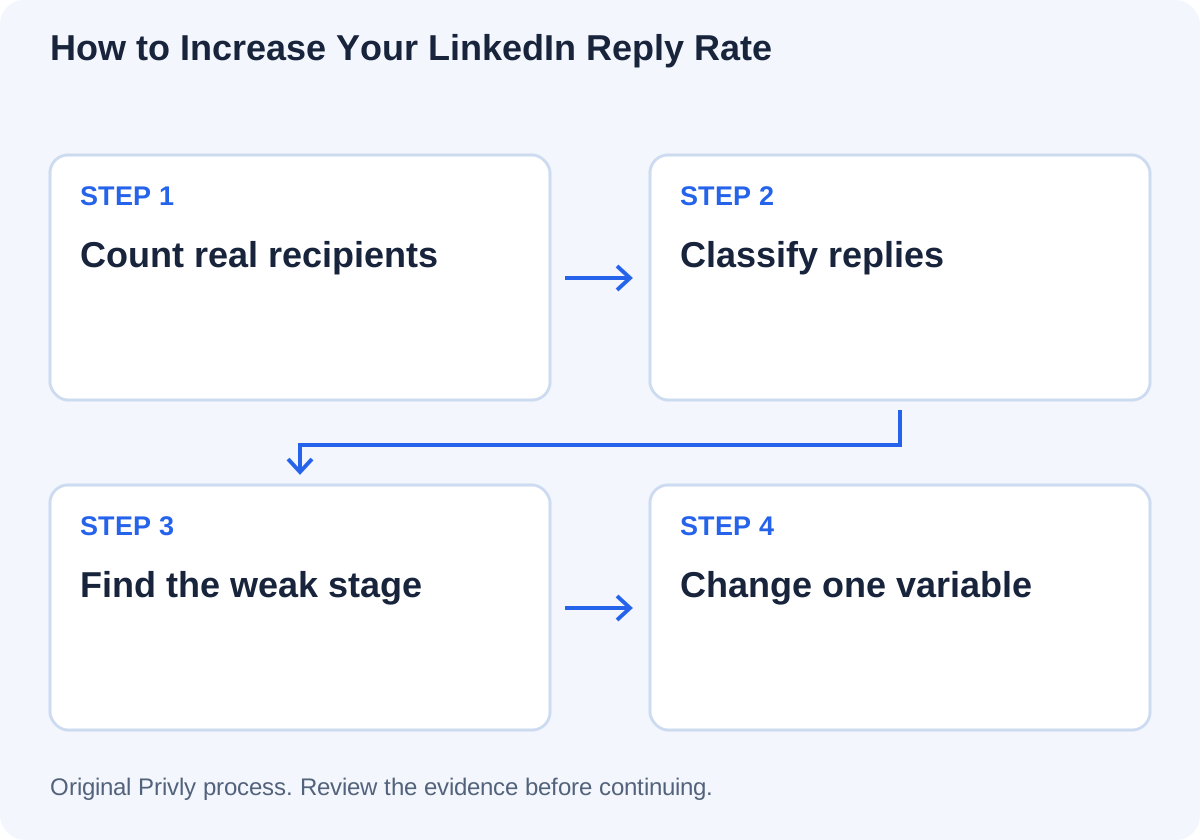
Diagnose the stage that needs attention
Read a sample of the actual threads before choosing a fix. Similar headline rates can hide different problems: an inappropriate audience, a vague offer, an unclear question, or an unanswered technical requirement.
| Pattern | Inspect first | A useful change to test |
|---|---|---|
| Few invitations accepted | Sender identity and reason to connect | Make the connection context truthful and recognizable. |
| Acceptance is healthy; few message replies | First-message relevance and effort to answer | Ask one question tied to a verified situation. |
| Many replies; little relevant interest | Audience fit and offer | Narrow the problem you can credibly resolve. |
| Interest without a next step | Unanswered requirements or unclear meeting purpose | Clarify what the next discussion would accomplish. |
| Meetings booked but not held | Scheduling and invitation clarity | Confirm timing, participants, and purpose. |
Use the ICP template for audience changes and the sales-call guide when the loss happens after interest.
Rewrite the message around an answerable question
Keep the observed fact, why it relates to your work, and one easy question. Remove generic compliments, unsupported familiarity, and a meeting request that arrives before the recipient understands the value. Shorten what does not help the person decide how to answer.
The second example assumes the sender actually read that statement and legitimately represents the offer. Adapt the facts rather than copying a claim into a new prospect’s thread. See the personalized message examples for other situations.
Use follow-up to add something useful
A follow-up should respond to the same situation and contribute a useful detail. If the person answers, stop treating the thread as unanswered. A refusal ends this approach. If they ask for information, provide it before repeating a meeting request.
Review the contact basis, platform rules, and any stop request before sending. The CASL guide explains Canadian email and LinkedIn message considerations. A reply-rate target does not override those boundaries.
Run a focused improvement experiment
Choose comparable prospects and define one outcome in advance. Keep the sender, offer, eligibility rules, observation period, and follow-up opportunity as similar as practical. Change one part of the process, such as the opening question, and record which version each person received.
If possible, allocate eligible people randomly to the versions and keep one company from receiving competing approaches. Include operator review time and any errors in the assessment. A small batch may reveal confusing wording or missing requirements without proving a statistically reliable lift.
Keep the result even when the revised message loses. Review whether the difference reflects the message, uneven audiences, or too few completed observations. Use the learning to choose the next specific question rather than declaring a universal winning template.
LinkedIn reply-rate questions
Start with a reviewed audience using Privly’s free ICP identifier, then use the diagnostic worksheet to choose one improvement.
Research and source notes
Sources reviewed October 23, 2026. Examples and calculations are authored illustrations; vendor documentation describes capabilities rather than comparative performance.
 CASL
CASL and Outbound Sales: Email and LinkedIn Prospecting in Canada
Review Canadian outbound email and LinkedIn messaging under CASL with official sources, consent and exemption distinctions, and a practical evidence checklist.
October 23, 2026 · Zyaam Ali Canadian B2B
Best LinkedIn Prospecting and Outreach Tools for Canadian Teams
Choose LinkedIn prospecting tools for a Canadian team with a sourced shortlist, CAD pricing context, review controls, and a practical selection worksheet.
October 23, 2026 · Giress Kenn AI Prospecting
AI Outreach Tools vs Manual Prospecting: Which Workflow Fits?
Compare AI-assisted and manual prospecting by task, review effort, evidence quality, and cost with a fair pilot plan and worked example.
October 23, 2026 · Zyaam Ali